
Frameworks
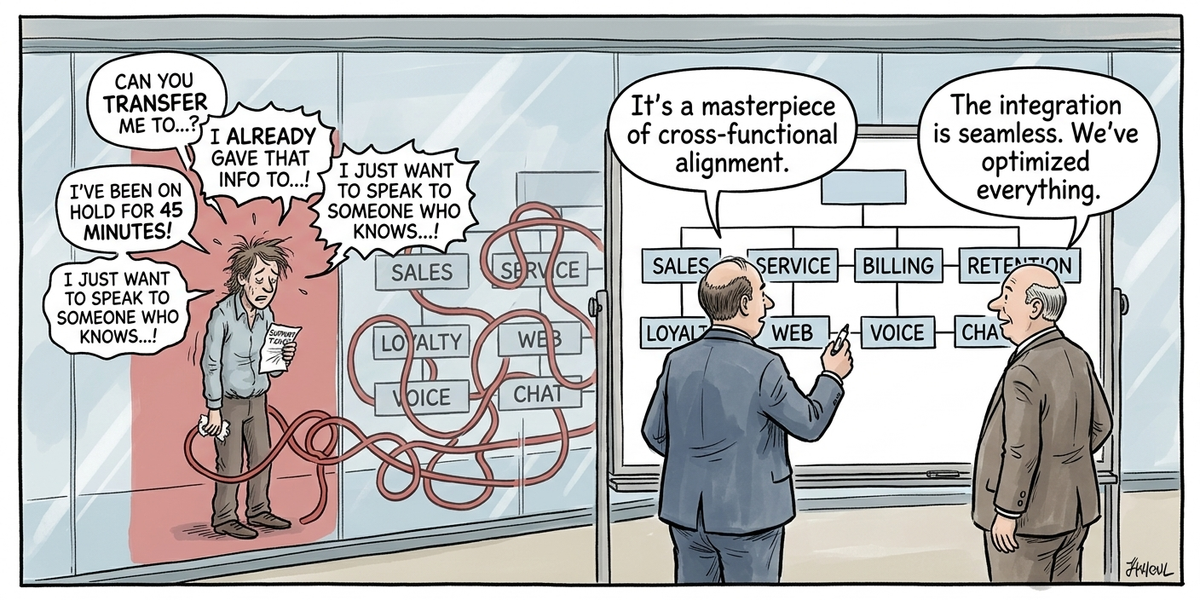
Three analytical frames I keep coming back to. Together they explain why your customer's experience is not what your org chart says it is.
The substate thesis; the Permission Stack; Conway's Law.
First, a short story...
Tuesday, 4:47 PM, April 2026. NYC, 5th Ave.
I'm waiting for a pair of sunglasses the store ordered for me three weeks ago, online. The associate at the register has been polite, patient, and increasingly trapped, because the system in front of him can do almost everything except the specific thing I'm asking it to do: find my order. The order was placed online, which means it lives in the e-commerce system. But it was this very store that were able to take my money one week ago and place the order. Now that same store cannot even process a refund, because it lives in a different system. The two systems cannot talk to each other. The store suggest I call customer service directly, because there is nothing they can do that I cannot do myself and they don't want to sit on hold. Me, the customer, the glue between their systems, the integration layer. The associate apologizes four times, but still cannot solve my problem. So instead, I'm on hold. Two weeks later my refund arrives. It's a gift card in an email with the headline "It's your lucky day". It absolutely is not. I'm on hold again. I'm not angry. I'm taking notes.
This is a small story. The sunglasses cost seventy-eight dollars. The aggregate cost to the retailer of every story like this, multiplied by every store and every category and every quarter, is somewhere between very large and existential.
But the story is also not really about the sunglasses, and not really about the systems, and not really about the associate, and not really (okay a little) about my pain. It is about the org chart. I won't name the retailer because picking on one would miss the point — multiply the same architecture by two dozen retailers I could name, and the failure mode is identical. Separate executives run e-commerce, retail, customer service, and loyalty. Each has a roadmap. None of those roadmaps say "make returning an online purchase in-store work the way the customer expects." That outcome would require four roadmaps to align, four systems to integrate, and four budgets to share priorities. Nothing about the org chart makes that easy.
This is where the publication starts. Most commentary on customer experience failure treats it as a vendor problem, a technology problem, or a training problem. I think it is an architecture problem. The architecture is organizational before it is technical.
The frames below are the three I keep coming back to. Together they form a single argument: the substrate is shifting, the permissions to operate on it are not granted by default, and the org chart is the constraint that makes or breaks whether you can grant them in time.
The substrate thesis
Every fifteen years or so, a new substrate redraws the map of who wins and who disappears. The container ship redrew it for global manufacturing. The personal computer redrew it for software. The smartphone redrew it for retail, transport, banking, and most of consumer media. The iPhone did not kill the taxi industry. It enabled the company that did.
Agentic AI is the substrate for customer experience. The enabling conditions have all arrived in the same window: transformer architectures that can reason and use tools, a protocol layer for agents to plug into enterprise systems, card networks publishing payment frameworks for autonomous transactions, and consumers already using agents to handle parts of their lives the incumbents assumed were locked in. None of these is, on its own, a transformation. Together they are the substrate. The companies that recognise the shift as one thing, rather than four separate trends, are the companies that survive it.
→ Read: the substrate thesis (forthcoming)
The Permission Stack
Most CX leadership conversations about agentic AI are stuck on the wrong question. The question being asked is can the agent do it? The answer is yes, in working form, today, in labs, in pilots, in production at companies whose names are on the buildings you can see from your office window. The capability is no longer the constraint.
The constraint is permission. And permission lives in five different places: Commercial, Tech, Legal, Cultural, and Organizational. Each has its own owner, its own clock, and its own way of failing quietly. A company can have four of the five and still ship nothing. A competitor with all five can ship everything. The Permission Stack is a one-page scorecard for the conversation your leadership team is currently having badly.
→ Read: the Permission Stack (forthcoming)
Conway's Law
In 1967, Mel Conway published a paper that reduced to a single observation: organizations design systems that mirror their own communication structure. Sixty years later, Conway's Law is the single most reliable diagnostic for why a major customer experience initiative fails. It is the reason the retailer above could not process my return. It is the reason large bank websites split navigation into Personal Banking, Investments, and Loans rather than around the customer's actual journey. It is the reason the contact-centre experience is structurally different from the app experience at companies where the contact centre and the app report up different VPs.
The agent-first version of this problem is sharper, and it is already visible in the wild. Agents inherit the seams of the teams that build them. The org chart ships itself, in agentic form. Whether you intend it to or not.
→ Read: Shipping the Org Chart (forthcoming)