Episode #3: the Enterprise Customer Experience story turns on the legal permission
This week in agentic AI and customer experience, in five minutes

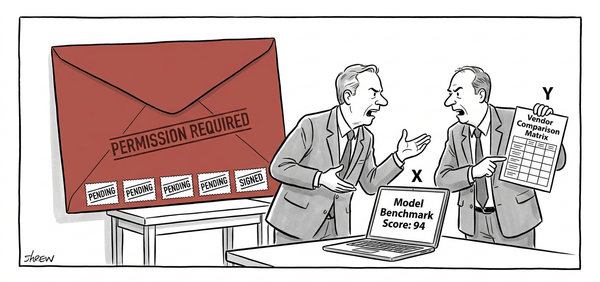
Three stories caught my attention, which look unrelated, but turn out to ask the same question. Who writes the rules for a customer-facing agent, the enterprise buying it, or the vendor selling it? The first is an Enterprise Customer Experience story, and it turns on the legal permission in my Permission Stack. The second is about Customer Experience leadership, and the quiet gap between buying AI and actually running it. The third is about agentic AI reaching past the customer and onto the contact-centre floor itself.
My read: the benchmark stopped being the story; the procurement question is now who makes agents cheap to run and safe to govern, and that's a different leaderboard.
From the Enterprise - what customers are actually doing
The buyers did more talking than usual this week, and the gap between what vendors are selling and what enterprises are actually running showed clearly: financial services kept pushing AI into the back office where the audit trail lives, travel began scaling guest-facing AI under explicit data guardrails, and a fresh body of evidence says a good deal of customer-service AI is quietly being walked back.
Revolut — puts AI ahead of its human reviewers for transaction monitoring
What happened: At Semafor's Banking on the Future Forum in Washington, Revolut US CEO Cetin Duransoy said AI now performs "statistically significantly better than human reviews" at transaction monitoring, with human reviewers kept for the complex cases. The same models generate customer-service answers from a user's own account data, trained hard against hallucination.
The read for your reader: When a regulated fintech will say on the record that the model out-performs its own analysts on a compliance-sensitive task, the burden of proof in your next risk-committee meeting shifts. The instructive part isn't "AI is better" — it's that Revolut kept humans on the hard cases and gave the machine the volume, which is the staffing model your contact centre will soon be asked to defend or rebut.
Wells Fargo — 26 AI use cases in production, 90,000 staff trained
What happened: Wells Fargo's AI platform now underpins 85% of its use cases, with 335 experiments run and 26 live in production; the bank has trained more than 90,000 employees and pushed AI tools to over 180,000 desktops, and is working with Google Cloud toward agents that interact across systems.
The read for your reader: This is the experiment-to-production funnel with real numbers attached — 335 in, 26 out. That conversion rate is the benchmark to hold your own pilot portfolio against, and the 90,000-trained figure is the tell that the binding constraint is enablement, not models. If your AI programme reports activity (experiments started) rather than throughput (use cases in production), you are measuring the wrong end of the funnel.
Marriott — natural-language search ships to guests, under a no-outside-model data rule
What happened: Marriott CIO Naveen Manga framed 2026 as "a year for scale," and CEO Anthony Capuano said a natural-language hotel search begins a phased rollout on Marriott's site and app this quarter, inside a four-part AI framework (trust, accountability, prioritisation, human-centred) that forbids exposing personal data to any model outside Marriott's enterprise. Marriott plans roughly $1.1B of investment this year, more than a third on digital and tech.
The read for your reader: Marriott is doing what every CX leader claims to want — a customer-facing conversational layer — and gating it behind an explicit data boundary. That posture ("no personal data to an outside model") is the legal-permission answer your own board will ask for before it signs off a guest-facing agent. Steal the framing, not just the feature.
Reality check — the customers are also rolling AI back
What happened: A finding reported on 13 May put roughly three-quarters of AI customer-service rollouts in the "letdown" column, with deployments scaled back at 74% of firms; diginomica's enterprise reporting points to the same cause — the blocker is organisational and data readiness, not model quality.
My read: Hold this next to the Wells Fargo funnel and the picture is consistent: the enterprises pulling ahead aren't the ones buying the most AI, they're the ones operationalising a few use cases properly. The question for your own review isn't "are we deploying AI" — it's "what fraction of what we deployed is still running six months later."
From the vendors
This was the week the industry stopped selling models and started selling the place you run them. Google put Managed Agents behind one API call and gave Workspace an always-on agent. Anthropic moved agent execution inside the enterprise boundary with MCP tunnels and self-hosted sandboxes. Microsoft began shipping Cloud PCs for agents and a registry for the shadow ones. Salesforce shipped MCP into Agent Fabric and conceded, in product form, that full autonomy isn't ready. Four vendors, one move: own the control plane, rent out the model.
Two numbers came unstuck. Gemini 3.5 Flash landed at roughly a third of frontier price, and Zendesk repriced service on resolutions rather than seats. Ramp's index showed Claude passing OpenAI in business adoption the same week OpenAI filed to go public above $1 trillion. And the buyers finally spoke: Revolut, Wells Fargo and Marriott each put figures to what they are actually running, even as fresh data showed three-quarters of those rollouts walked back.
- Google I/O — Gemini 3.5 Flash, Spark 24/7 agent, Managed Agents API, $1B savings claim, 20% Ultra price cut.
- Ramp index — Claude passes OpenAI in business adoption as OpenAI files to go public.
- Zendesk Relate 2026 — Autonomous Service Workforce priced on resolutions, not seats.
- OpenAI confidential IPO filing — targeting a valuation above $1 trillion, September listing in view.
- Assembled MCP server — contact-centre WFM analytics as a plain-language question.
- Anthropic Claude Managed Agents — MCP tunnels and self-hosted sandboxes move execution inside the boundary.
- Microsoft — Windows 365 for Agents, shadow-AI discovery, and the E7 governance bundle.
- Circle Agent Stack — wallets, marketplace and nanopayments for autonomous agents.
- Salesforce Agent Fabric — MCP support lands; "guided determinism" concedes autonomy isn't ready.
- Quiq — voice added to the agent platform, with the 88/25/7 operating-gap data.