The Audit Trail Is the New Moat
Three governance launches in a single week. The new enterprise lock-in is not which model wins; it is whose audit trail your agents register against.

A clearing-house floor in 1923, somewhere off Cedar Street in Lower Manhattan. Rows of polished ledger desks under tall windows. Clerks in shirt sleeves and ties, pencils behind their ears, hunched over balance sheets at end-of-day. Between two of the desks, an auditor mid-stride, a closed ledger in his hands.
A century later, the audit trail is still the most expensive line item in finance. It just became the most expensive line item in agentic AI.
Three vendors shipped governance products in the first week of May 2026. One went generally available. One repositioned an entire company around it. One released the open-source counterweight. Read the announcements separately and they look like ordinary product news. Read them together and they describe a different kind of platform war than the one most CIOs are still preparing for. The lock-in nobody is naming has already moved one layer up the stack.
The 2024 platform war was about which model wins. That argument is over and it does not particularly matter. The 2026 platform war is about whose audit trail your agents register against. The companies that figure that out before their next renewal will spend the next decade collecting compounding switching costs. The companies that do not will spend the next decade paying them.
The week it became visible
Microsoft moved Agent 365 to general availability on 1 May. Each agent now gets its own Microsoft Entra Agent ID — identity, lifecycle, access management, all enrolled into the same directory the workforce already lives in. The product also ships with registry sync into AWS Bedrock and Google Cloud, which is Microsoft volunteering to be the identity broker even when the agent itself is hosted on a competitor's cloud. Standalone pricing is $15 per user per month.
A week later, ServiceNow CEO Bill McDermott opened the company's Knowledge 2026 conference by repositioning ServiceNow entirely. The company is no longer a workflow platform; it is "the AI agent of agents," in McDermott's framing. ServiceNow shipped Otto (a unified AI experience), Action Fabric (an open MCP server letting any agent execute governed work on the platform), and AI Control Tower (extended across Microsoft and NVIDIA). The Control Tower is free for the first year, a $2 million value at list.
The same week, WSO2 announced the beta of Agent Manager, an open-source agent control plane under Apache 2.0, with general availability scheduled for June. The product solves the same problem from the open-source side. The category gets its credible second option before its first option has finished shipping.
Three vendors. Three different bets. One conviction.
The lock-in moves up the stack
Three governance launches in seven days is not a coincidence. The companies shipping these products have noticed something the average CIO procurement deck has not.
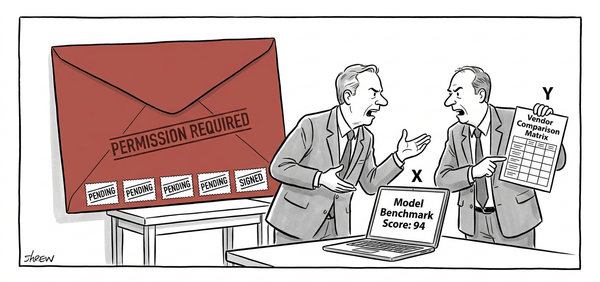
Model choice is a procurement decision. A line item, with a vendor, on a renewal cycle, swappable when a competitor outperforms on a benchmark. Painful to migrate, certainly, but bounded — the cost of moving from Claude to Gemini is the cost of re-evaluating prompts and re-running pilots. Twelve months of work, give or take.
Governance plane is an architectural decision. The identity registry your agents enrol into. The audit trail your auditors interrogate. The intervention points your compliance officer relies on under the EU AI Act's August 2 deadline. The gateway behaviour your CISO has signed off on. Once your agent fleet is registered against a governance plane, switching it is not a procurement exercise. It is an architecture migration, and architecture migrations run on a different calendar.
The asymmetry is the whole story. Architectural decisions outlast procurement decisions by a factor of three to ten years. The CIO who picks a model this year will pick a different one in two years. The CIO who picks a governance plane this year will still be running it, mostly unchanged, six or seven years from now. My read: the vendors shipping governance products this month know exactly which clock they are running on. They are racing to be the registry the rest of the agent fleet inherits, because once they are, the rest of the agent fleet is captive whether the underlying models change or not.
The pricing tell
Two of the three launches priced themselves into a recognisable shape. ServiceNow's AI Control Tower is free for the first year. Microsoft Agent 365 is $15 per user per month standalone, or bundled into the new $99 Microsoft 365 E7 SKU. The marketing register reads as generous. The architecture register reads as something else.
The cost-of-entry to a governed agent fleet has been engineered to be small. The cost-of-exit has been engineered to be enormous. Free-for-a-year is the cleanest version of the play: by the twelve-month mark, your audit trails are populated, your CISO has signed off on the architecture, your agents are registered, and your compliance posture is documented against the registry. The replacement cost at month thirteen is the cost of redoing all of it. That cost is precisely the cost of staying.
The $15-per-user-month line item works the same way through different mechanics. Per-seat pricing makes the budget conversation easy. Per-seat lock-in makes the architecture conversation impossible. By the time finance asks whether the renewal is worth it, the answer was set by an integration decision someone made eighteen months earlier, when the goal was getting an agent into production rather than thinking about an architecture choice that nobody would otherwise have noticed.
The pricing is the moat.
Picking on purpose
The CIO sitting through their next vendor meeting is going to hear about model performance. The vendor will be earnest, the slides will be good, the demo will be canned, and the question that actually matters will not appear on any of the slides.
You are not picking a model vendor. You are picking a governance plane. Twelve months from now you will have one. The only question is whether you chose it on purpose or whether your first three agent deployments chose it for you. The companies that will look back on 2026 as the year they got expensive are the companies whose CISOs registered against whichever governance plane the first vendor demo showed.
This is the first of several pieces tracing the substrate underneath the agent economy. Next: how the customer becomes the integration layer that the org chart never quite managed to build.