Planet of the Apps
More apps are being shipped right now than at any point in history. They are being shipped into a world that is about to stop needing them.
Tuesday, 7:14 AM.
Maya's kettle clicks off and she pours the water without looking, because she's listening to Ivy.
"So I pushed back on the Delta change fee," Ivy is saying, in the voice Maya picked out eighteen months ago — warm, a little dry, the cadence of a friend who's been up slightly longer than you. "They tried to quote the non-refundable fare rules, but I pulled up the weather advisory from Tuesday and cited it against their own inclement weather policy. They refunded it. Also, your mother's cardiologist's office called back. I rescheduled her to the 21st because you have the Henderson review on the 14th and I didn't think you'd want to be in two places."
Maya nods into her mug. "Thanks. Did Chase ever sort out the duplicate charge?"
"Yesterday. I didn't want to wake you. They tried to send it to a human agent and I told them we'd already been through that loop twice this quarter, so they escalated it and reversed it in about four minutes. I logged the transcript in case you want to see it, but you won't."
She won't.
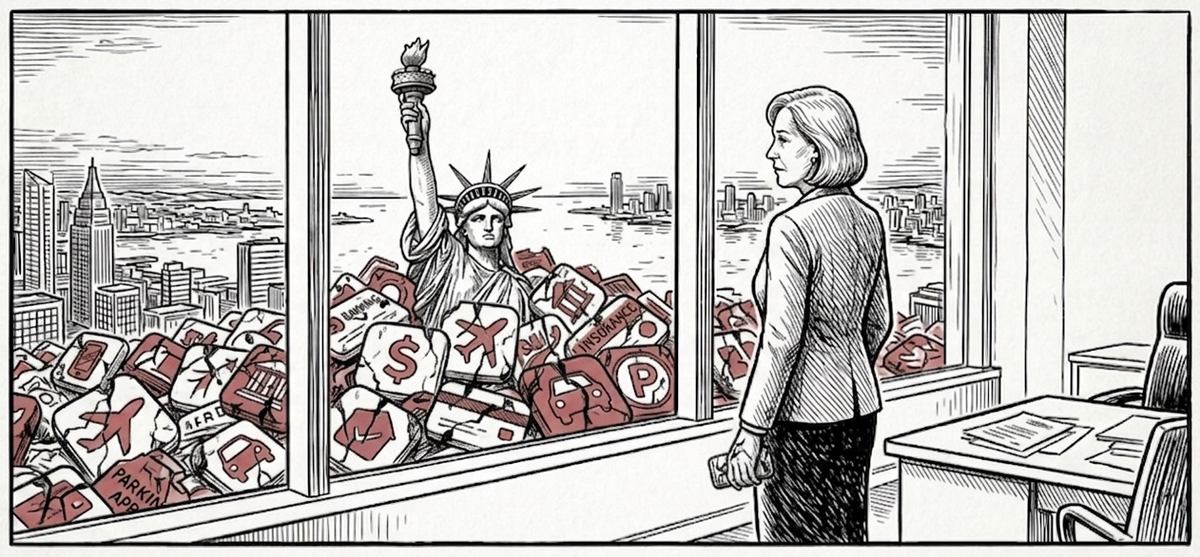
Maya opens her phone out of habit, the way a smoker reaches for a pocket that's been empty for years. The home screen is mostly blank now. There's a camera. A messages app for the handful of people who still text her directly instead of going through their own agents. A weather widget she keeps for sentimental reasons, the way her grandmother kept a barometer on the kitchen wall. The banking app is gone. The airline apps are gone. The insurance portal, the pharmacy portal, the utility portal, the three different grocery apps, the parking app, the other parking app, the app for the gym she quit, the app for the gym she joined, the loyalty app that tracked the loyalty app that tracked the loyalty app — all gone. Not deleted in a dramatic purge. Just quietly unused, the way landlines got quiet, until one day she noticed the screen was mostly wallpaper and felt, unexpectedly, like she'd gotten something back.
"Ivy, what's on today?"
"You've got the Henderson prep at ten. Before that, your sister wants fifteen minutes — she didn't say what about, but her agent flagged it as personal, not urgent. I held the slot at 8:45. And I need about thirty seconds from you on the mortgage refi, because I've got three offers and I can't tell which one you'd actually want. It's a values question, not a numbers question."
Maya smiles. A values question. Eighteen months ago she was on hold with her bank for forty-one minutes trying to dispute a nine-dollar fee, listening to a recording tell her how important her call was, pressing one for English, pressing two for account services, pressing zero in desperation, getting transferred to a queue, getting disconnected, calling back. She remembers the specific shade of rage it produced, a rage so familiar it had become a kind of weather.
She doesn't miss it.
"Okay," she says. "Walk me through the three."
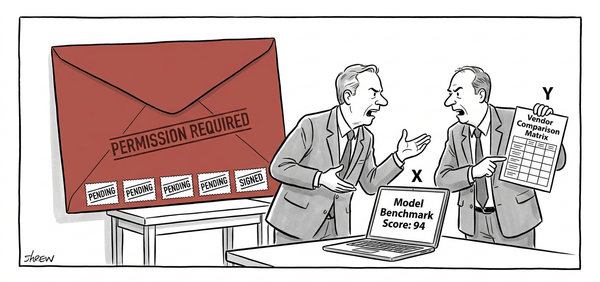
Maya isn't real. Ivy isn't real. The Tuesday morning I just described is somewhere between four and nine years away, depending on which part of it you're looking at and which analyst you trust. But almost none of it is speculative in the way that phrase usually implies. Every capability in that scene — the cross-enterprise negotiation, the policy citation, the calendar reconciliation, the quiet refusal to be handed to a human — exists in working form today, in labs, in pilots, in the roadmaps of companies whose names are on the buildings you can see from your office window. What doesn't exist yet isn't the technology. It's the permission.
Tech permission
That's the big thing most people get wrong. The Tech exists today. For those of you familiar with Model Context Protocol (MCP), you'll already know this. For those that don't, there's a protocol gaining huge momentum across the industry called MCP — think of it as a universal adapter that lets any AI agent plug into any company's systems the same way a USB-C cable lets any device plug into any charger. It doesn't matter who made the agent or who built the system. The plug fits. The intended use, similar to APIs, is for software companies and enterprise applications and they're being adopted faster than anyone expected. And the very same MCP server an enterprise exposes to its own internal AI agents is technically indistinguishable from one it could expose to a customer's personal agent. The only reason your customers aren't using it through their own agents instead of your app is that nobody has flipped the switch on the auth model.
Legal permission
With new technologies, come new questions and liability is a critical one. When I ask my agent to move my money, who is liable? Me, the Agent or the bank for allowing the Agent? How do enterprises distinguish between Agents used as good and bad actor? It feels like an unsolvable question - and even though I am not here to solve it - these questions always get solved. Probably in the EU first. Probably within 5 years. And the enterprises ready for it will stand to benefit greatly. Those lobbying against it, will lose.
Commercial permission
And yet there will be many that resist. Airlines don't want flight search to be a commodity. Banks don't want you to see all your balances in one dashboard. Insurers don't want you to compare policies. Telcos don't want you to know what you're actually paying for. The app isn't a service layer; it's a friction layer, and the friction is the margin. A personal-agent world is a world where that friction evaporates, and a lot of the profit goes with it. That's the uncomfortable truth for many software companies and enterprises, as they read this. Many cannot pivot even when they can see exactly what it coming. The org that built the friction layer is the org that gets defunded if the friction goes away, and companies don't reorganize around a future that threatens next quarter's number. This is why the resistance will be real, well-funded, and, ultimately, irrelevant. When Spotify arrived, the music industry spent a decade suing the future instead of building for it. The labels that survived weren't the ones that fought hardest; they were the ones that figured out what they were actually selling once the plastic disc was gone. The answer turned out to be access, curation, and trust — not the container. The enterprises and software companies that survive the personal-agent shift will be the ones that ask the same question: what are we actually selling once the app is gone?
Cultural permission
'But we need the customer's permission first?' Did Uber ask permission? Netflix? Spotify? Stripe? No. They didn't.
I could give you stats and data and trends around AI adoption. But that would be missing the point - and frankly a little dull (yeah, we get it, even my mum uses ChatGPT). But this isnt about adoption curves, it's about the existing frustration customers have with what has come before. The Apps' reign of terror is coming to an end. Every forty-one-minute hold, every dark pattern, every forced update, every "we've detected unusual activity," every loyalty program that was actually a surveillance program — the incumbents have spent thirty years making deposits in an account that's about to get withdrawn all at once. Customers are already waiting for somewhere else to go and that place is on the horizon, ready to welcome them with open arms.
Thursday, 6:47 PM.
The dashboard has been open on Nadia's second monitor for three hours, but she hasn't looked at it in two. She already knows what it says. App engagement is down 14% year over year, for the third consecutive quarter. The customer satisfaction scores are up, which should feel like a win but doesn't, because the customers who are most satisfied are the ones who stopped using the app entirely. Their agents call the MCP server directly now. Clean, fast, no friction. No hold music. No cross-sell. No upsell. No five-screen flow that nudges them toward the premium tier. Just a question, an answer, and a clean disconnect.
Nadia is the Chief Customer Officer. She built the app. Not personally — she inherited it, championed it, defended its budget through four restructures and two CEOs. She was the one who argued that the app was the relationship. That engagement was loyalty. That every screen, every notification, every carefully designed friction point was a touchpoint, and touchpoints were the product.
She was wrong and she's known it for about six months. She hasn't said it out loud yet.
She stands and walks to the window. Sixty-eight floors below, the city is doing what it always does. From up here you can see the harbor, the old financial district, the skyline she's watched change for fifteen years, with the exception of Lady Liberty still standing strong. Watching the cars descend into Manhattan over Brooklyn Bridge something occurs to her — not for the first time, but with a clarity that feels new — that the app was never the relationship. The app was the toll booth. And the customers didn't leave because they found a better toll booth. They left because someone built a bridge.
She picks up her phone. Opens Slack. Types a message to her product lead, deletes it, types it again.
"What if the customer never wanted the app? What if they just wanted the answer."
She sends it before she can delete it a second time.