We're Debating the Wrong Question
The CRM vs. CCaaS convergence debate is a $20 billion turf war while agentic AI is coming for the $250 billion labour market beneath it.
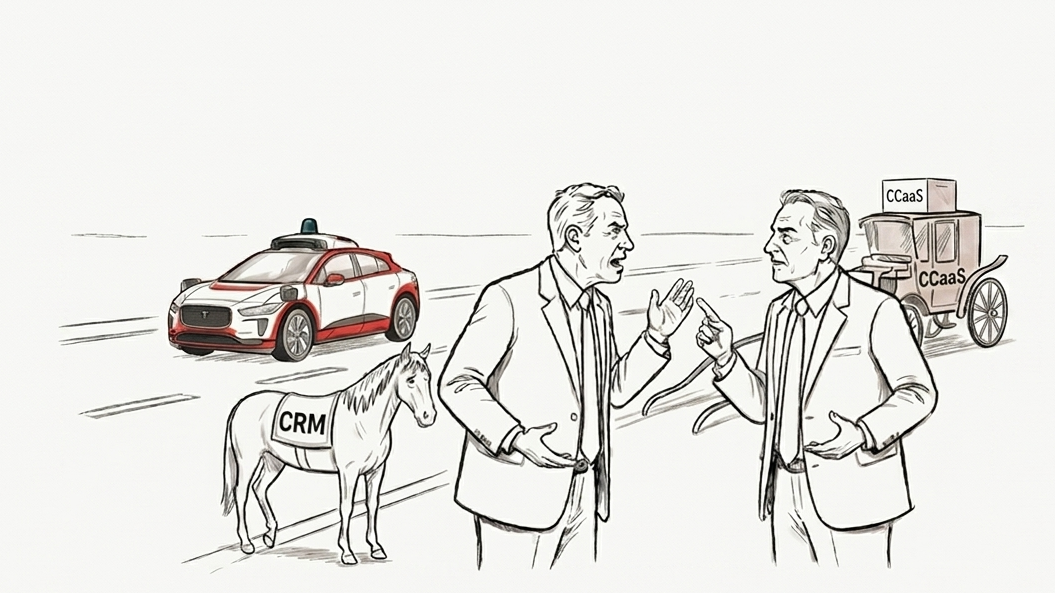
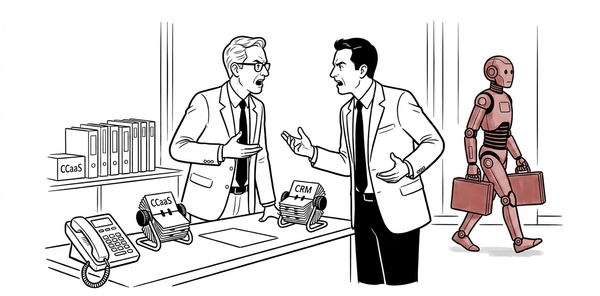
Watching the CRM vs. CCaaS convergence debate in 2026 feels like walking in on two people arguing about whether the horse or the carriage should own the road — while a Waymo glides past the window.
Salesforce has launched Agentforce Contact Center. The CCaaS incumbents are pushing back. LinkedIn is doing what LinkedIn does. And the industry is earnestly relitigating a question that, I'd argue, has already been overtaken by the thing we should actually be talking about.
So let me say it plainly: the platform debate is the wrong debate.
Steelmanning both sides, briefly
Salesforce's case is coherent. One platform, one data model, less context-switching, cleaner inputs for AI. If you believe the future of CX is a single system of record feeding a single system of engagement, consolidation is the logical endgame.
The CCaaS counter is equally coherent. As one CCaaS executive put it in CX Today: "the challenge isn't consolidation — it's coordination." Most enterprises don't run on one system. They run on dozens. And they're not trying to change that.
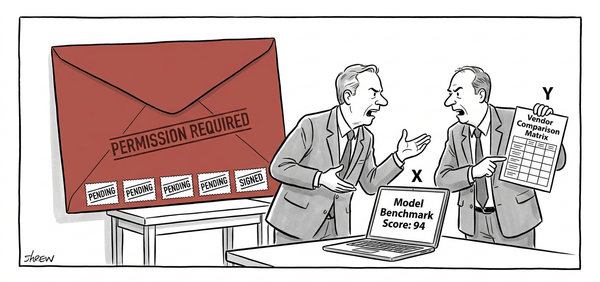
Both camps are arguing in good faith. Both are also arguing about the wrong thing.
The numbers nobody's stacking together
Simon Leyland, CEO of Cloud Interact, laid out the market math in a way worth pausing on: CCaaS and telecoms at roughly $20 billion. CX services at around $100 billion. Human agent labor at $250 billion a year.
Read that last number again.
Salesforce isn't buying its way into a contact center category. It's buying a lottery ticket on the $250 billion line item that agentic AI is coming for — regardless of which platform wins. The CRM vs. CCaaS debate is about who owns a $20 billion software market. Agentic AI is about who automates a $250 billion labor market. These are not the same conversation. One is a turf war. The other is a tectonic shift.
Gartner's recent warning against slashing support teams to fund AI is the tell. Enterprises can feel the ground moving. They just haven't architected for it yet.
CRM is data at rest
Even if you win the convergence argument, you've only unified two stationary systems.
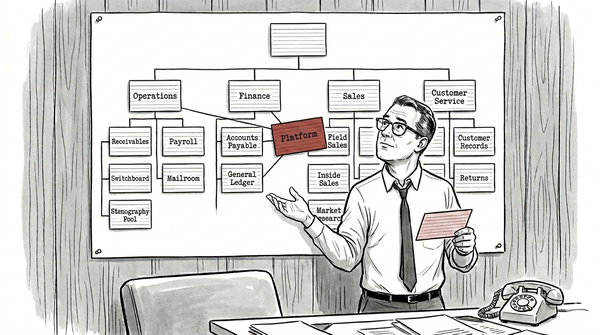
CRM was designed as a system of record. Fields, objects, pipelines, closed-won. It tells you what happened. It does not tell you what the customer meant, how they felt, what they tried on three other channels before picking up the phone, or what they're about to do next. A CRM is a photo album. Agentic CX needs a live camera feed.
IP Integration put it bluntly in a recent piece: your CRM isn't your customer experience platform. Forrester has been circling the same idea for years, describing CRM and CCaaS vendors as "frenemies forever" — structurally in tension because they were built for different jobs. Bolting them together doesn't dissolve the tension. It just moves it inside the same invoice.
The uncomfortable truth for the convergence camp is that "data at rest, beautifully organized" was the winning architecture of the last decade. The winning architecture of the next one is data in motion — context, signals, and intent flowing across systems in real time, to agents (human and otherwise) that can actually act on it.
None of this is to say Salesforce is wrong to move. They're moving because they have to. But let's be honest about where the product actually is. Agentforce Contact Center currently ships in the UK, US, and Canada. It lacks native workforce management, a non-trivial gap for any enterprise running a mature contact center. And as Leyland points out, "enterprises haven't spent 10–15 years building complex architectures just to rip them out overnight."
By the time the average Fortune 500 finishes a CRM-plus-CCaaS consolidation, the winning architecture will have changed twice. This is not a Salesforce problem. It's a physics problem. Enterprise migrations move in years; agentic AI is moving in quarters. One of those timelines is going to bend, and it won't be the laws of procurement.
Where the conversation actually is
The real question isn't which platform owns the customer. It's which orchestration layer lets every system — CRM, CCaaS, billing, logistics, the half-dozen SaaS tools nobody remembers buying — speak to every agent in real time.
That layer has a name now. Model Context Protocol (MCP) and Agent-to-Agent (A2A) are the emerging standards explicitly being flagged as the infrastructure for what comes next. They matter because they make the consolidation question moot. If any agent can access any context from any system, it doesn't matter whose logo is on the login screen. The experience layer stops being a platform and starts being a protocol.
That's the conversation I want to have. The convergence debate will resolve itself — not because someone wins, but because the room has already moved on.
Next in this series: why CRM is data at rest, and what data in motion actually looks like.